
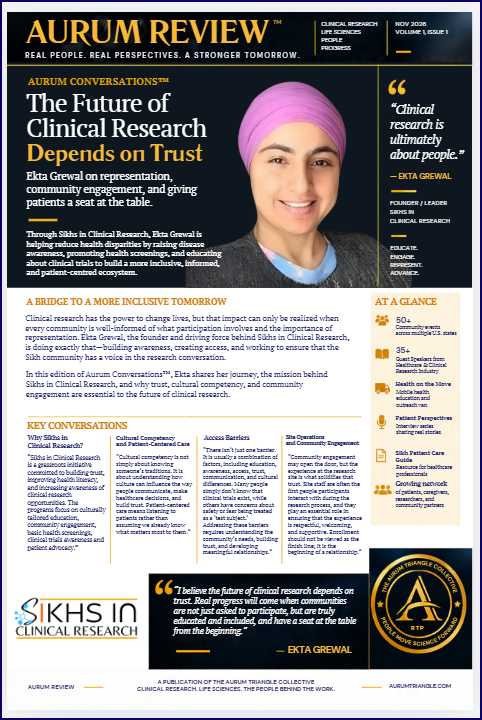
A Bridge to a More Inclusive Tomorrow
Clinical research has the power to change lives, but that impact can only be realized when every community is well-informed of what participation involves and the importance of representation. Ekta Grewal, the founder and driving force behind Sikhs in Clinical Research, is doing exactly that—building awareness, creating access, and working to ensure that the Sikh community has a voice in the research conversation.
In this edition of Aurum Conversations™, Ekta shares her journey, the mission behind Sikhs in Clinical Research, and why trust, cultural competency, and community engagement are essential to the future of clinical research.
From an overlooked gap to a growing platform
Grewal created Sikhs in Clinical Research after recognizing how little awareness existed about clinical trials within the Sikh community. Many people had never heard of clinical research, did not understand what participation involved, or lacked access to information presented in a familiar and culturally relevant way.
What began as an effort to improve awareness has grown into work involving health education, disease awareness, patient advocacy, cultural competency, community engagement, and health equity. The organization has held more than 50 community events across several states and brought more than 35 guest speakers into conversations about healthcare and clinical-research careers.
“Education becomes much more powerful when people can actually relate to it.”
Trust begins before recruitment
Grewal reflects the idea that underrepresented communities are not difficult to reach when we take the right approach. The deeper challenge is that the industry has to build the right relationships and communicate in ways that feel relevant and relatable to the people they hope to involve. That requires investing in communities and showing up consistently, not only when participants are needed for a study.
Barriers rarely arrive one at a time. Awareness, language, transportation, work schedules, caregiving responsibilities, access to healthcare, privacy concerns, and mistrust can all shape whether someone is comfortable considering a study. Addressing those concerns requires relationships long before recruitment begins.
The site experience must keep the promise
Transportation, scheduling, language access, caregiver involvement, communication preferences, and the way study information is explained all matter. Enrollment is not the finish line. Retention depends on whether participants continue to feel informed, supported, and valued throughout the research journey.
Mentorship is part of inclusion
Grewal’s work also extends to people trying to enter or advance within clinical research. She views mentorship as a way to change the trajectory of someone’s career by making an unfamiliar industry easier to navigate.
Her advice is direct: start with what you know and what you care about. Listen to patients, researchers, and healthcare professionals. Identify a gap, and do not assume important work requires a large organization or perfect plan.
Innovation still requires human connection
Grewal is encouraged by decentralization, digital health, real-world data, and more patient-centered approaches. Still, she cautions that trust is built through relationships, communication, listening, and human connection. The future will require innovation and genuine human connection working together.
“I want communities not only to be invited to participate in research, but to have a strong voice in shaping how research is discussed, designed, and delivered.”
— Ekta GrewalThe complete conversation
The feature above presents the edited magazine story. Ekta’s complete responses are preserved below for readers who want to explore every topic.
1. What inspired you to start Sikhs in Clinical Research, and what gap were you hoping to address?
Sikhs in Clinical Research was born from seeing a gap that was difficult to ignore. As someone working in clinical research, I saw firsthand how important representation, trust, and education are to the success of clinical research. At the same time, there was very little awareness about clinical trials within the U.S. Sikh community. Many people had never heard of clinical trials, did not understand what participation involved, or had questions because they lacked access to information in a way that felt familiar and easy to understand.
Sikhs in Clinical Research was created to address that gap by educating the community, building awareness, encouraging conversations, improving representation, and ultimately making health and research education more accessible and inclusive for the Sikh community.
2. How has the mission evolved since its launch, and what impact have you seen so far?
The mission has grown significantly. What began with a focus on awareness around clinical research has evolved into a broader effort around health education, disease awareness, patient advocacy, cultural competency, community engagement, and health equity. We have hosted 50+ community events across different states in the U.S. These events have allowed us to have conversations directly with community members and also, through surveys, understand which diseases are more prevalent in the community and where more education, awareness, and support are needed. Our work and data insights have also been published across various industry platforms.
One of the most significant outcomes has been seeing people become more comfortable asking questions and sharing their stories and health journeys. When someone tells you, “I didn't know clinical trials were an option,” or asks what participation actually means, that conversation itself is an important step. We have also seen the importance of providing information in culturally and linguistically appropriate ways at their trusted places, delivered through trusted community messengers. Education becomes much more powerful when people can actually relate to it.
Our work has expanded beyond community outreach. We have engaged with healthcare professionals, researchers, academic institutions, patient advocacy organizations, and others through professional conferences, educational sessions, speaking opportunities, panel discussions, and poster presentations. These opportunities have allowed us to bring community perspectives into broader healthcare and clinical research conversations while also learning from others in the field.
3. You’ve been a strong advocate for cultural competency and patient-centered care. Why do you believe these are essential to the future of clinical research?
Clinical research is ultimately about people. We can have excellent protocols and innovative therapies, but if patients do not feel understood, respected, or represented, we will continue to struggle with participation and retention. Cultural competency is not simply about knowing someone's traditions. It is about understanding that culture can influence how people communicate, make healthcare decisions, interact with providers, understand illness, and build trust.
As part of our work, we have started organizing webinars focused on helping healthcare professionals better understand how to provide compassionate care to Sikh patients. One of the resources we developed is our Sikh Patient Care Guide, which provides information to help healthcare professionals better understand the faith, beliefs, values, and individual preferences of Sikh patients.
Patient-centered care means listening to the patient rather than assuming we already know what matters to them. For clinical research to become more inclusive, we need to move beyond simply asking diverse populations to participate. We need to understand what makes participation comfortable for them, and that requires listening to communities.
4. From your perspective, what are some of the biggest barriers that still prevent diverse communities from participating in clinical trials?
There isn't one single barrier. It is usually a combination of education, awareness, access, trust, communication, and cultural factors. Many people simply don't know that clinical trials exist or don't realize that there may be an option for them. Others may have concerns about safety, privacy, or being treated like a “test subject.” There can also be mistrust of the healthcare or research system, misconceptions about clinical trials, fear of receiving a concerning diagnosis or test result, and cultural beliefs that may influence how people approach healthcare and research.
Language and health literacy can create significant barriers as well. For some people, barriers can begin even before they reach their regular screening appointments due to a lack of health insurance. There are also practical barriers, such as transportation, work schedules, demographic factors, and caregiving responsibilities. Addressing these barriers requires understanding what the community needs and building relationships and trust well before a person is approached about a clinical trial.
Through our community engagement, educational work, and conversations with patients and families, we have also seen how important it is to understand what the community is actually experiencing. Community members can tell us where the gaps are, what they do not understand, what concerns them, and what prevents them from seeking care or considering research participation.
5. What strategies or initiatives have you found most effective in building trust and awareness within underrepresented communities?
For me, the most effective strategy has been meeting people where they are. We also have a van called “Health on the Move,” which allows us to bring health education and awareness directly into the community, especially across the Midwest region. Community events, educational sessions, collaborations with other organizations, culturally relevant educational materials, and conversations in familiar settings have all been valuable. We also focus on making complex medical and research information understandable rather than using terminology that can create distance.
Our Patient Perspectives interview series has been a particularly important initiative because hearing someone's lived experience communicates something that a brochure or statistic cannot.
Another important piece is consistency. Trust doesn't happen because you hold one event or distribute one brochure. It develops when the community sees that you are present, that you listen, and that you come back.
I also believe strongly in involving community members in the conversation rather than simply communicating information to them. Ask what they want to know. Ask what concerns them. Ask what would make them comfortable participating. That two-way dialogue is where true engagement begins.
6. How do you see site operations and community engagement working together to improve trial enrollment and retention?
I see them as two parts of the same process.
Community engagement can help create awareness and trust, but that trust has to be supported by a positive experience once someone enters a clinical trial. If the site experience doesn't reflect the expectations created through community outreach, we lose an important opportunity.
Sites need to understand the communities they serve. This means thinking about transportation, scheduling, language access, communication preferences, caregiver involvement, or simply how study information is explained. Enrollment should not be viewed as the finish line. Retention depends on whether participants feel respected, informed, supported, and valued throughout the research journey.
Our work with the community also gives us an opportunity to understand health concerns, awareness gaps, and perceptions around healthcare and research. That information can be valuable when thinking about how research organizations and sites engage with communities and communicate with potential participants.
7. What role does mentorship play in developing the next generation of clinical research professionals, and how do you approach mentoring others?
I believe mentorship can change the trajectory of someone’s career. Clinical research can be difficult to navigate when you don't have someone to explain the industry, share their experiences, or help you understand where you can fit in.
For me, mentorship is about being willing to share what I have learned and creating opportunities for others. I try to help people understand the different paths within clinical research and connect them with the right resources and people where possible.
We have hosted 35+ guest speakers with diverse backgrounds in the healthcare and clinical research industry who have shared their career journeys and provided opportunities to explore mentor-mentee relationships across the community. We have also created opportunities for students and individuals interested in clinical research to learn more about the field, career pathways, and available reference materials and training resources.
One of the things I value most is seeing someone I have mentored become more confident, take on new responsibilities, or create opportunities for themselves that they may not have thought were possible.
8. What changes in the clinical research industry are you most excited about right now?
I'm excited about the growing conversation around decentralization, digital health, patient-centered care, real-world data, and more inclusive approaches to clinical trial participation.
But what excites me most is the increasing recognition that patients and communities need to be part of the research conversation. AI and technology can help us reach people in new ways, but technology alone won't solve the trust problem. I think the future will require both innovation and genuine human connection.
9. Where do you see the greatest opportunity for collaboration across organizations and stakeholders to drive meaningful change?
There is a tremendous opportunity for collaboration between sponsors, CROs, research sites, healthcare providers, patient advocacy organizations, and community organizations.
Community organizations understand their communities. Sites understand trial operations. Sponsors and CROs understand the development process. Patient advocates understand the patient experience. Academic and public health organizations bring additional research and population-level perspectives. If we bring those perspectives together earlier, we can design better approaches to engagement and participation. Each relationship creates an opportunity to learn, share information, and bring the community perspective into a larger conversation.
I would especially like to see more partnerships with community organizations. The community should have a seat at the table from the beginning.
10. What advice would you give to someone who wants to make a difference in clinical research or patient advocacy but isn’t sure where to start?
Start with what you know and what you care about. You don't need to have a huge organization, a large budget, or a perfect plan to begin making an impact. Start by listening to people, identifying a gap, and asking what you can do to help address it.
Learn continuously. Talk to patients. Talk to researchers. Talk to healthcare professionals. Understand both sides of the conversation. And don't underestimate small actions. One educational conversation can change someone's understanding of clinical research. One introduction can create a career opportunity. One partnership can reach an entire community.
There are also many ways to contribute. You can educate, volunteer, conduct surveys, share patient experiences, create resources, support community programs, mentor others, or simply help start a conversation. Impact does not always have to begin with a large initiative.
If you see a gap, don't always wait for someone else to solve it. Sometimes the best way forward is simply to start.
Closing: Is there anything else about your story, your work, or your vision for the future of clinical research that you’d like our readers to know?
I believe the future of clinical research depends on trust.
My work with Sikhs in Clinical Research has reinforced for me that communities are not difficult to reach when we take the time to understand them. Sometimes the real issue is that we haven't built the right relationships or communicated in a way that feels relevant to them.
My vision is for clinical research to become something that communities understand, feel comfortable discussing, and see themselves represented in. I want communities not only to be invited to participate in research, but to have a strong voice in shaping how research is discussed, designed, and delivered.
Explore Ekta’s work.
Learn more about Ekta Grewal’s community education, patient advocacy, and clinical-research awareness work through Sikhs in Clinical Research.
Visit Sikhs in Clinical Research ↗Who should we speak with next?
Aurum Conversations™ highlights the people, experiences, and perspectives shaping clinical research and the life sciences.
If you would like to be considered for a future conversation—or know someone whose work and perspective deserve wider attention—we invite you to reach out.
Request a conversation Recommend someoneThe Aurum Review™ may use AI-assisted and other editorial tools to support select aspects of editing, presentation, research, and accuracy review. All published material is subject to human editorial oversight, and responsibility for final content remains with The Aurum Review and the credited author or contributor, as applicable.